
Skilled Trades Offer Veterans a Direct Path to High-Demand Careers
Paid apprenticeships, on-the-job training and growing employer demand are creating strong career opportunities for Veterans across construction, manufacturing, defense and maritime industries.
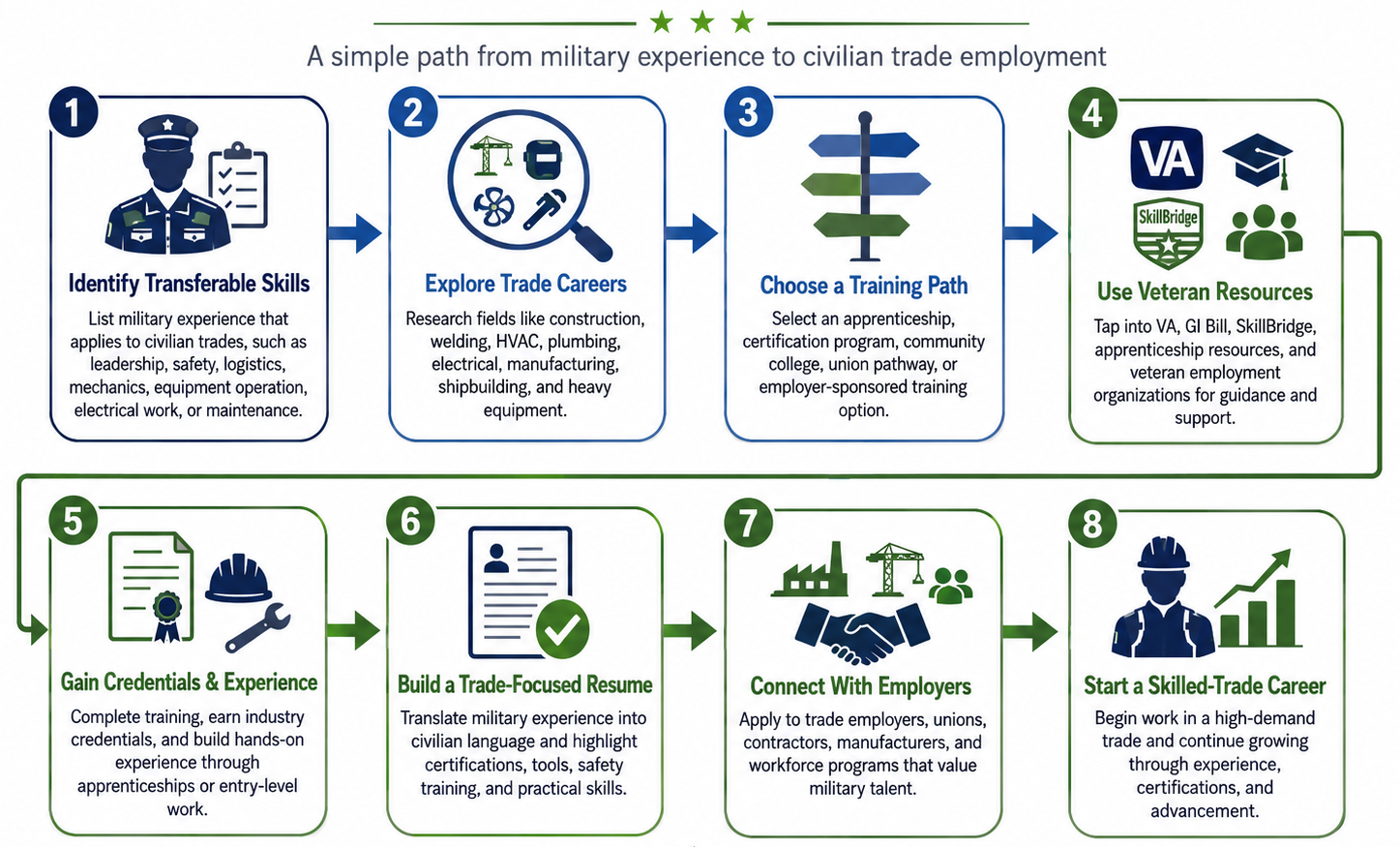
For many Veterans transitioning into civilian employment, the challenge is not a lack of valuable experience. It is finding employers and career pathways that recognize how military training, technical knowledge, leadership and discipline translate into the civilian workforce.
Skilled trades may offer one of the clearest paths forward.
The U.S. Department of Veterans Affairs recently highlighted growing opportunities for Veterans in construction, skilled manufacturing, defense and maritime industries. Many of these careers do not require a traditional four-year college degree and instead provide paid apprenticeships, industry-recognized training or on-the-job instruction.
That combination can make skilled trades especially valuable for Veterans who want to begin earning quickly while continuing to build specialized skills.
Employers Need Skilled Workers
The United States continues to face a significant shortage of trained workers in several essential industries.
According to the VA, the country currently has approximately:
- 447,000 open construction jobs
- 94,000 open skilled-manufacturing jobs
- A projected need for 174,000 additional shipbuilding workers during the next decade
These shortages represent more than a national workforce challenge. They also represent a major employment opportunity for Veterans whose military backgrounds may already include mechanical work, logistics, equipment operation, electronics, engineering, construction, maintenance, transportation or team leadership.
Even when a Veteran’s exact military occupation does not have an obvious civilian equivalent, the underlying abilities developed through military service can remain highly relevant. Employers in skilled industries frequently need dependable workers who can follow complex procedures, operate safely, solve problems under pressure and work effectively as part of a team.
Veterans bring those qualities to the workplace.
An Earn-While-You-Learn Alternative
One of the greatest advantages of skilled-trade careers is the availability of apprenticeships.
Unlike career paths that may require individuals to spend several years paying for education before they can begin working, apprenticeships allow participants to earn wages while receiving classroom instruction and supervised, hands-on experience.
Depending on the occupation, Veterans may pursue careers in areas such as:
- Electrical work
- Plumbing and pipefitting
- Welding
- Carpentry and construction
- Heating, ventilation and air conditioning
- Advanced manufacturing
- Industrial maintenance
- Heavy-equipment operation
- Automotive and diesel technology
- Shipbuilding and maritime trades
Many apprenticeship programs also lead to portable credentials, wage increases and long-term advancement opportunities.
For Veterans concerned about beginning an entirely new career after leaving military service, the apprenticeship model can provide a structured transition that feels familiar: clear expectations, practical training, progressive responsibility and measurable advancement.
Connecting Veterans With Real Opportunities
The VA and the U.S. Department of Labor are working together to improve how Veterans are referred to apprenticeships, employment programs and hiring opportunities.
The agencies are convening employers, workforce organizations, educators and training providers to identify barriers and strengthen the connection between Veterans and industries experiencing worker shortages. Priorities include improving the transition between the Department of Defense and VA, expanding employer networks, increasing awareness of SkillBridge and making employment resources easier for Veterans to navigate.
This coordination is important because information alone is not enough.
Veterans need clear pathways from military service to training, credentials, interviews and employment. Employers also need assistance understanding military experience and identifying candidates whose skills may not be immediately apparent from a conventional résumé.
Organizations such as Helmets to Hardhats, Apprenticeship.gov, the Department of Labor’s Veterans’ Employment and Training Service and VA employment programs can help Veterans explore these pathways.
GI Go Fund’s Commitment to Veteran Employment
At GI Go Fund, we understand that every Veteran’s employment journey is different.
Some Veterans are looking for an immediate job. Others need help translating their military experience, improving their résumé, obtaining a credential, identifying a new career field or connecting with employers that understand the value of military service.
Our employment and career-support efforts are designed to help Veterans evaluate their options and move toward sustainable careers that match their abilities, interests and goals.
Skilled trades should be an important part of that conversation.
These careers offer the potential for competitive wages, advancement, job stability and meaningful work in industries that are essential to the country’s infrastructure, manufacturing capacity and national security.
For many Veterans, the question may not be whether they possess valuable skills. The question is how to connect those skills to the employers and training programs that need them.
As demand for skilled workers continues to grow, Veterans should be positioned at the front of the line.
Veterans interested in employment assistance, career planning or training opportunities can contact GI Go Fund to learn more about available resources and support.
Source: U.S. Department of Veterans Affairs, “The paths to high-demand careers in the skilled trades,” published July 23, 2026.